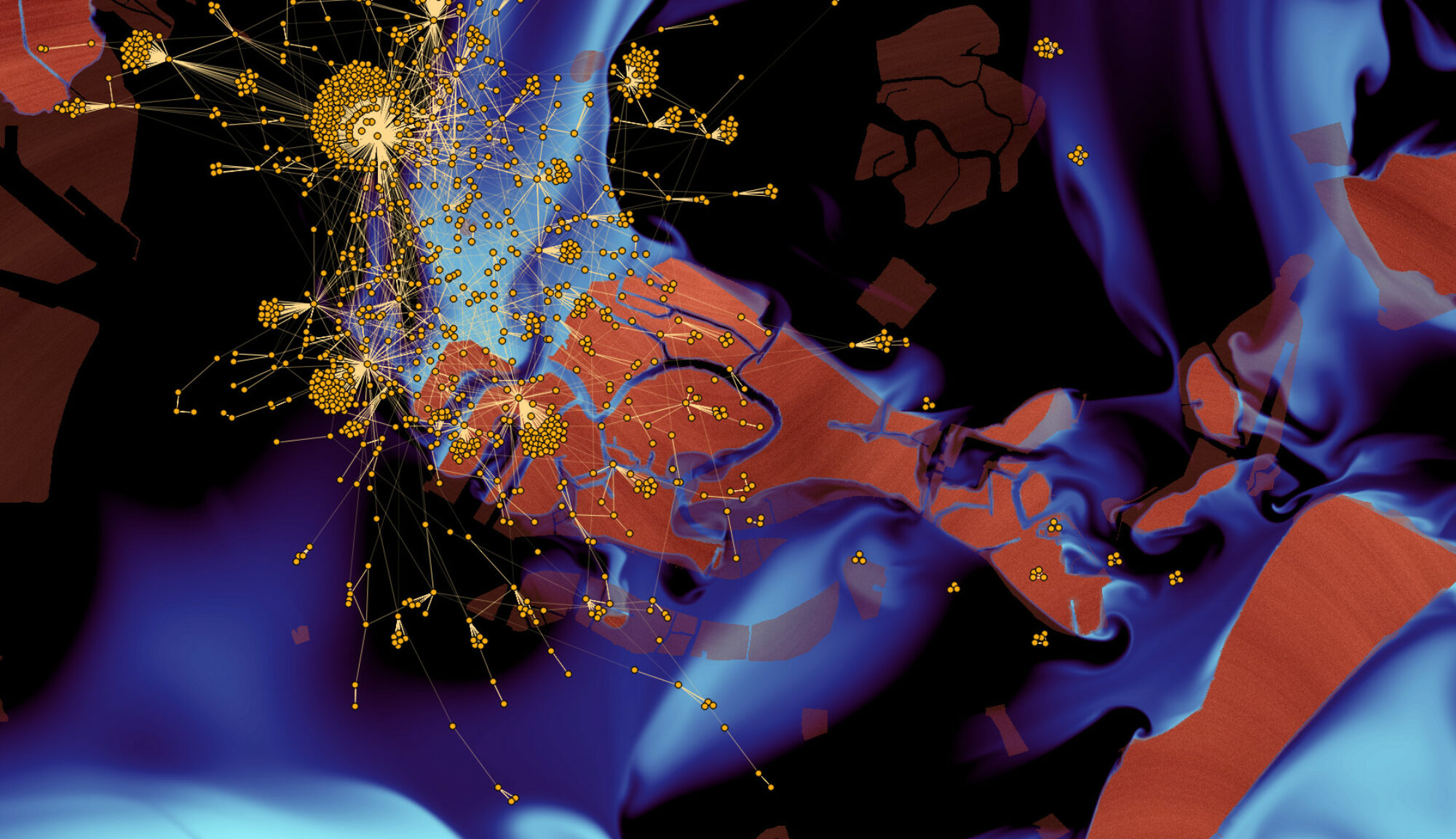
Spreading of the Happy Flu experiment
Evolving networks
Pierre Borgnat, Eric Fleury, Jean-Loup Guillaume, Clémence Magnien, Céline Robardet et Antoine Scherrer
Proceedings of NATO Advanced Study Institute on Mining Massive Data Sets for Security, IOS Press, 2008
Most real networks often evolve through time: changes of topology can occur if some nodes and/or edges appear and/or disappear, and the types or weights of nodes and edges can also change even if the topology stays static. Mobile devices with wireless capabilities (mobile phones, laptops, etc.) are a typical example of evolving networks where nodes or users are spread in the environment and connections between users can only occur if they are near each other. This whois- near-whom network evolves every time users move and communication services (such as the spread of any information) will deeply rely on the mobility and on the characteristics of the underlying network. This paper presents some recent results concerning the characterization of the dynamics of complex networks through three different angles: evolution of some parameters on snapshots of the network, parameters describing the evolution itself, and intermediate approaches consisting in the study of specific phenomena or users of interest through time.
Basic Notions for the Analysis of Large Two-mode Networks
Matthieu Latapy, Clémence Magnien and Nathalie Del Vecchio
Social Networks (2008), vol. 30, no1, pp. 31-48
Many large real-world networks actually have a 2-mode nature: their nodes may be separated into two classes, the links being between nodes of different classes only. Despite this, and despite the fact that many ad-hoc tools have been designed for the study of special cases, very few exist to analyse (describe, extract relevant information) such networks in a systematic way. We propose here an extension of the most basic notions used nowadays to analyse large 1-mode networks (the classical case) to the 2-mode case. To achieve this, we introduce a set of simple statistics, which we discuss by comparing their values on a representative set of real-world networks and on their random versions. This makes it possible to evaluate their relevance in capturing properties of interest in 2-mode networks.
Detection, Understanding, and Prevention of Traceroute Measurement Artifacts
Fabien Viger, Brice Augustin, Xavier Cuvellier, Clémence Magnien, Matthieu Latapy, Timur Friedman, and Renata Teixeira
Computer Networks 52-5 (2008), pp. 998-1018. Extended abstract published in the proceedings of the 6-th Internet Measurement Conference IMC’06, 2006, Rio de Janeiro, Brazil
Test of time award IMC 2022
Traceroute is widely used: from the diagnosis of network problems to the assemblage of internet maps. Unfortunately, there are a number of problems with traceroute methodology, which lead to the inference of erroneous routes. This paper studies particular structures arising in nearly all traceroute measurements. We characterize them as « loops », « cycles », and « diamonds ». We identify load balancing as a possible cause for the appearance of false loops, cycles and diamonds, i.e., artifacts that do not represent the internet topology. We provide a new publicly-available traceroute, called Paris traceroute, which, by controlling the packet header contents, provides a truer picture of the actual routes that packets follow. We performed measurements, from the perspective of a single source tracing towards multiple destinations, and Paris traceroute allowed us to show that many of the particular structures we observe are indeed traceroute measurement artifacts.
Complex Network Measurements: Estimating the Relevance of Observed Properties
Matthieu Latapy and Clémence Magnien
Infocom’08 Proceedings, Phoenix, USA
Complex networks, modeled as large graphs, received much attention during these last years. However, data on such networks is only available through intricate measurement procedures. Until recently, most studies assumed that these procedures eventually lead to samples large enough to be representative of the whole, at least concerning some key properties. This has crucial impact on network modeling and simulation, which rely on these properties. Recent contributions proved that this approach may be misleading, but no solution has been proposed. We provide here the first practical way to distinguish between cases where it is indeed misleading, and cases where the observed properties may be trusted. It consists in studying how the properties of interest evolve when the sample grows, and in particular whether they reach a steady state or not. In order to illustrate this method and to demonstrate its relevance, we apply it to data-sets on complex network measurements that are representative of the ones commonly used. The obtained results show that the method fulfills its goals very well. We moreover identify some properties which seem easier to evaluate in practice, thus opening interesting perspectives.
The yooooo distribution
Local leaders in random networks
Vincent D. Blondel, Jean-Loup Guillaume, Julien M. Hendrickx, Cristobald de Kerchove and Renaud Lambiotte
Phys. Rev. E 77, 036114 (2008)
We consider local leaders in random uncorrelated networks, i.e., nodes whose degree is higher than or equal to the degree of all their neighbors. An analytical expression is found for the probability for a node of degree k to be a local leader. This quantity is shown to exhibit a transition from a situation where high-degree nodes are local leaders to a situation where they are not, when the tail of the degree distribution behaves like the power law ~k^gamma_c with gamma_c=3. Theoretical results are verified by computer simulations, and the importance of finite-size effects is discussed.
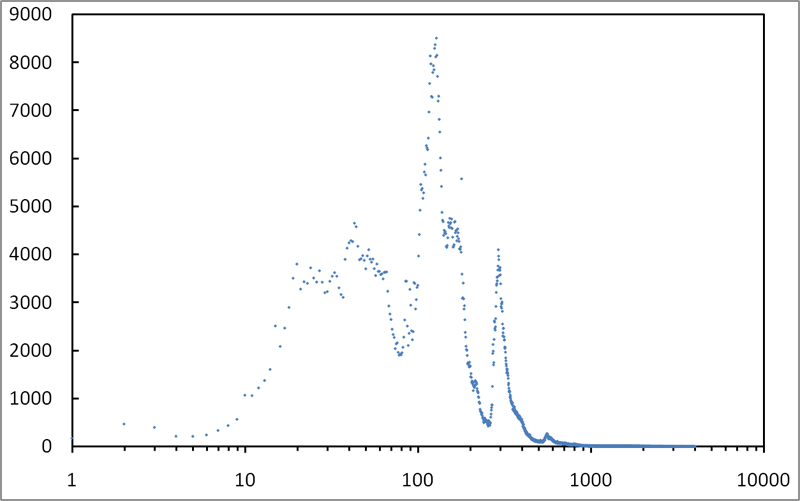
Paedophile content in Peer-to-Peer exchanges
Random graph exploration with shortest paths
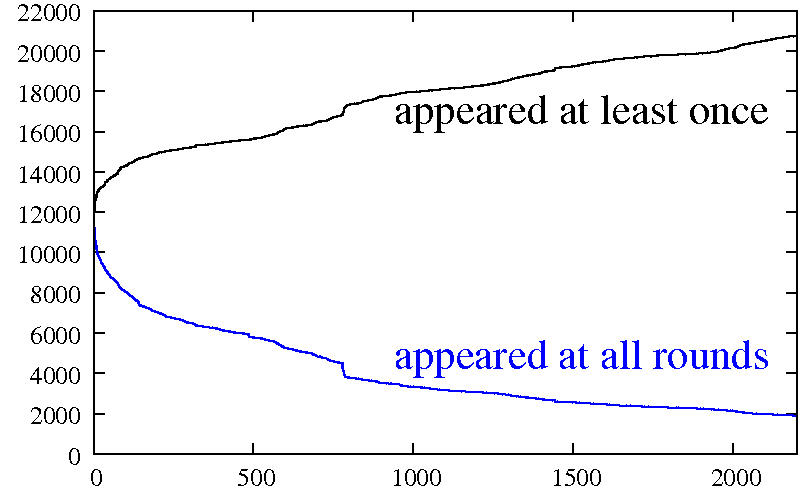
Growth of the number of IP around me
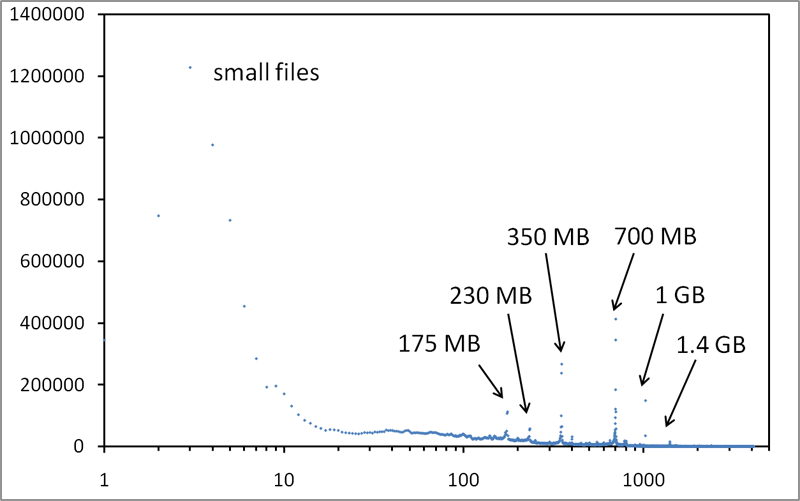
P2P file size distribution
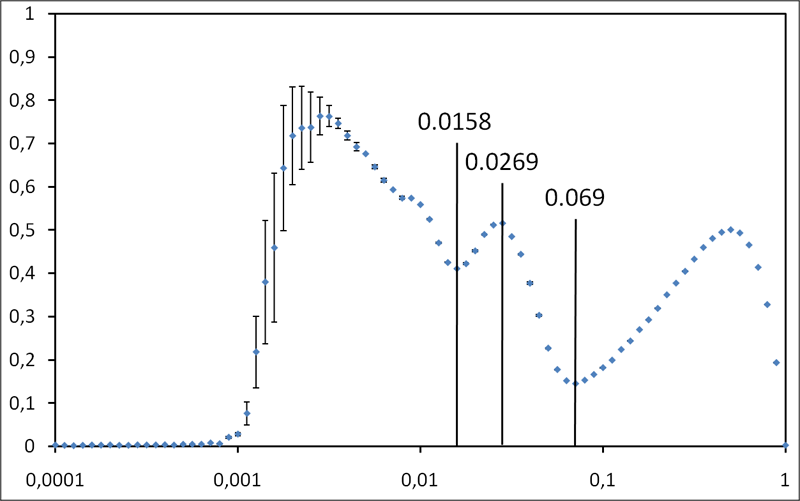
RTT distribution
Distance distribution in random graphs and application to network exploration
Vincent D. Blondel, Jean-Loup Guillaume, Julien M. Hendrickx, and Raphaël M. Jungers
Phys. Rev. E 76, 066101 (2007)
We consider the problem of determining the proportion of edges that are discovered in an ErdsRényigraph when one constructs all shortest paths from a given source node to all other nodes. This problem is equivalent to the one of determining the proportion of edges connecting nodes that are at identical distance from the source node. The evolution of this quantity with the probability of existence of the edges exhibits intriguing oscillatory behavior. In order to perform our analysis, we introduce a different way of computing the distribution of distances between nodes. Our method outperforms previous similar analyses and leads to estimates that coincide remarkably well with numerical simulations. It allows us to characterize the phase transitions appearing when the connectivity probability varies.
Multi-level analysis of an interaction network between individuals in a mailing-list
Rémi Dorat, Matthieu Latapy, Bernard Conein and Nicolas Auray
Annals of Telecommunications (2007), vol. 62, no3-4, pp. 325-349
It is well known now that most real-world complex networks have some properties which make them very different from random networks. In the case of interactions between authors of messages in a mailing-list, however, a multi-level structure may be responsible for some of these properties. We propose here a rigorous but simple formalism to investigate this question, and we apply it to an archive of the Debian user mailing-list. This leads to the identification of some properties which may indeed be explained this way, and of some properties which need deeper analysis.
Describing and simulating routes on the Internet
Jérémie Leguay, Matthieu Latapy, Timur Friedman, Kavé Salamatian
Computer Networks 51, pages 2067-2087, 2007. Extended abstract published in LNCS, proceedings of the 4-th IFIP international conference on Networking, 2005, Waterloo, Canada
This contribution deals with actual routes followed by packets on the internet at IP level. We first propose a set of statistical properties to analyse such routes, which brings detailed information on them. We then use the obtained results to suggest and evaluate methods for generating artificial routes suitable for simulation purposes. This also makes it possible to evaluate various network models. This work is based on large data sets provided mainly by CAIDA’s skitter infrastructure.
Theoretical Computer Science special issue on Complex Networks – foreword
Ravi Kumar and Matthieu Latapy
Theoretical Computer Science, special issue on Complex Networks, Volume 355, Number 1, 6 April 2006
Bipartite graphs as Models of Complex Networks
Jean-Loup Guillaume and Matthieu Latapy
Physica A 371, pages 795-813, 2006. Extended abstract published in LNCS, proceedings of the 1-st international workshop on Combinatorial and Algorithmic Aspects of Networking CAAN’04, 2004, Banff, Canada
It appeared recently that the classical random graph model used to represent real-world complex networks does not capture their main properties. Since then, various attempts have been made to provide accurate models. We study here the first model which achieves the following challenges: it produces graphs which have the three main wanted properties (clustering, degree distribution, average distance), it is based on some real-world observations, and it is sufficiently simple to make it possible to prove its main properties. This model consists in sampling a random bipartite graph with prescribed degree distribution. Indeed, we show that any complex network can be viewed as a bipartite graph with some specific characteristics, and that its main properties can be viewed as consequences of this underlying structure. We also propose a growing model based on this observation.
Dynamics of three-state excitable units on Poisson vs power-law random networks
Anne-Ruxandra Carvunis, Matthieu Latapy, Annick Lesne, Clémence Magnien and Laurent Pezard
Physica A 367, pages 585-612, 2006
The influence of the network topology on the dynamics of systems of coupled excitable units is studied numerically and demonstrates a lower dynamical variability for power-law networks than for Poisson ones. This effect which reflects a robust collective excitable behavior is however lower than that observed for diffusion processes or network robustness. Instead, the presence (and number) of triangles and larger loops in the networks appears as a parameter with strong influence on the considered dynamics.
Computing communities in large networks using random walks
Pascal Pons and Matthieu Latapy
Journal of Graph Algorithms and Applications (JGAA) vol. 10, no. 2, pages 191-218, 2006. Extended abstract published in LNCS, proceedings of the 20-th International Symposium on Computer and Information Sciences ISCIS’05, 2005, Istambul, Turquie
Dense subgraphs of sparse graphs (communities), which appear in most real-world complex networks, play an important role in many contexts. Computing them however is generally expensive. We propose here a measure of similarities between vertices based on random walks which has several important advantages: it captures well the community structure in a network, it can be computed efficiently, and it can be used in an agglomerative algorithm to compute efficiently the community structure of a network. We propose such an algorithm, called Walktrap, which runs in time O(mn) and space O(n) in the worst case, and in time O(n log n) and space O(n) in most real-world cases (n and m are respectively the number of vertices and edges in the input graph). Extensive comparison tests show that our algorithm surpasses previously proposed ones concerning the quality of the obtained community structures and that it stands among the best ones concerning the running time.