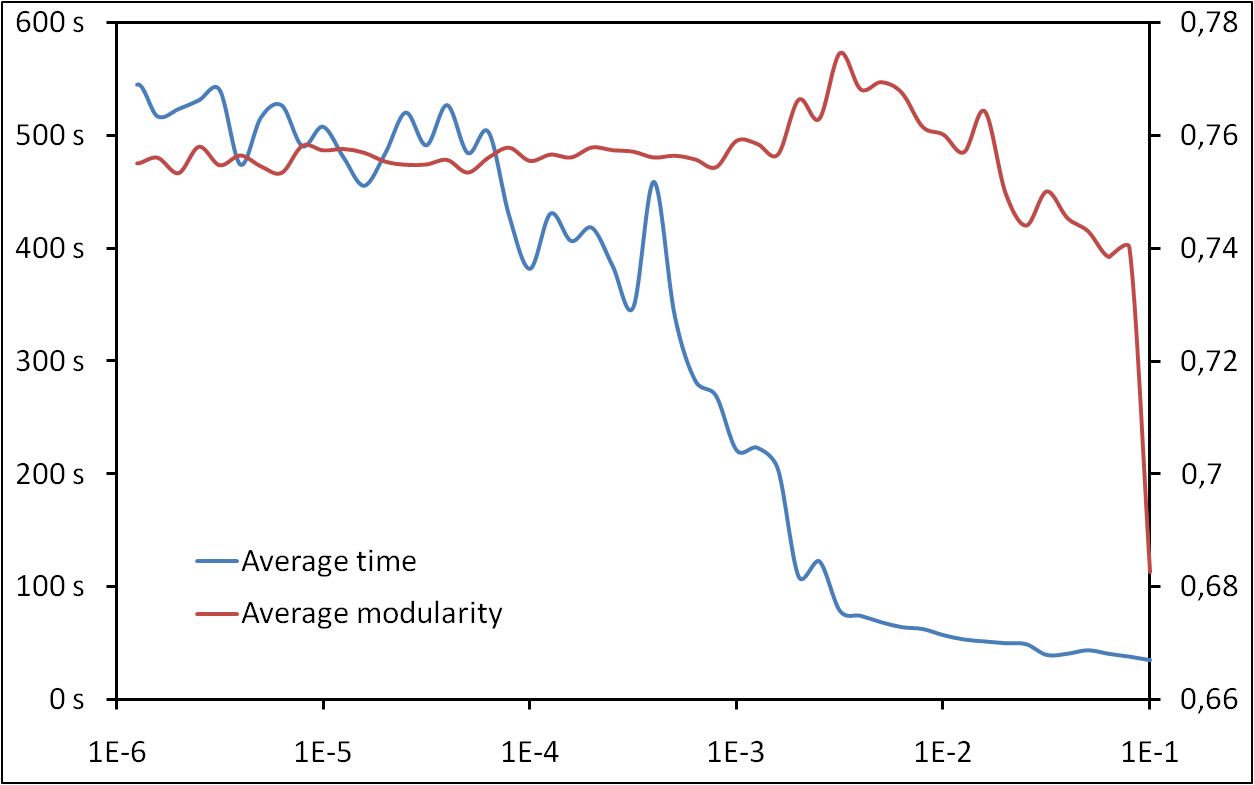
Spreading of a file in a P2P system
We are interested in all aspects of real world networks and their models, from internet measurements to random graphs, from social network analysis to spreading phenomena, and from graph algorithms to biological networks.
Fabien Tarissan, Matthieu Latapy and Christophe Prieur
In Proceedings of the IEEE International Workshop on Network Science For Communication Networks (NetSciCom’09)
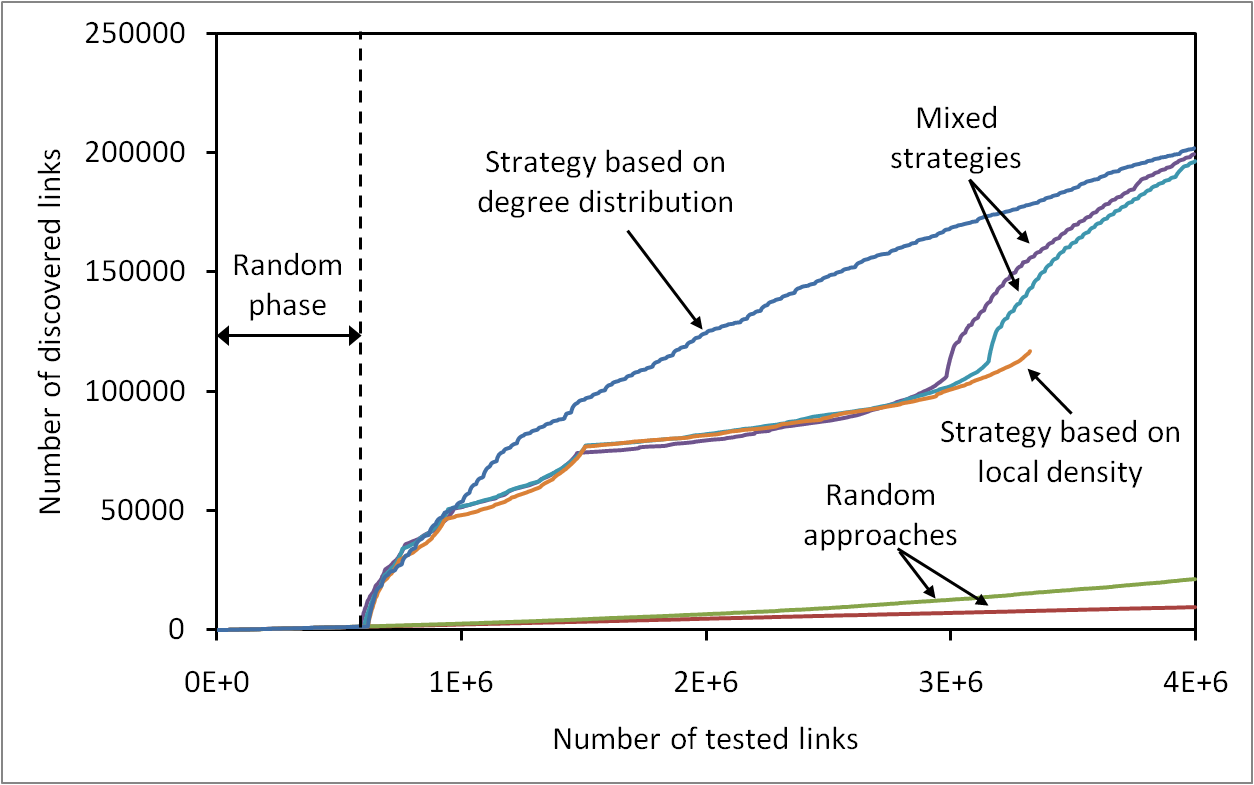
Complex networks are at the core of an intense research activity. However, in most cases, intricate and costly measurement procedures are needed to explore their structure. In some cases, these measurements rely on link queries: given two nodes, it is possible to test the existence of a link between them. These tests may be costly, and thus minimizing their number while maximizing the number of discovered links is a key issue. This is a challenging task, though, as initially no information is known on the network. This paper studies this problem: we observe that properties classically observed on real-world complex networks give hints for their efficient measurement; we derive simple principles and several measurement strategies based on this, and experimentally evaluate their efficiency on real-world cases. In order to do so, we introduce methods to evaluate the efficiency of strategies. We also explore the bias that different measurement strategies may induce.
Frédéric Aidouni, Matthieu Latapy and Clémence Magnien
Sixth International Workshop on Hot Topics in Peer-to-Peer Systems (Hot-P2P 2009), May 29, 2009, Rome, Italy
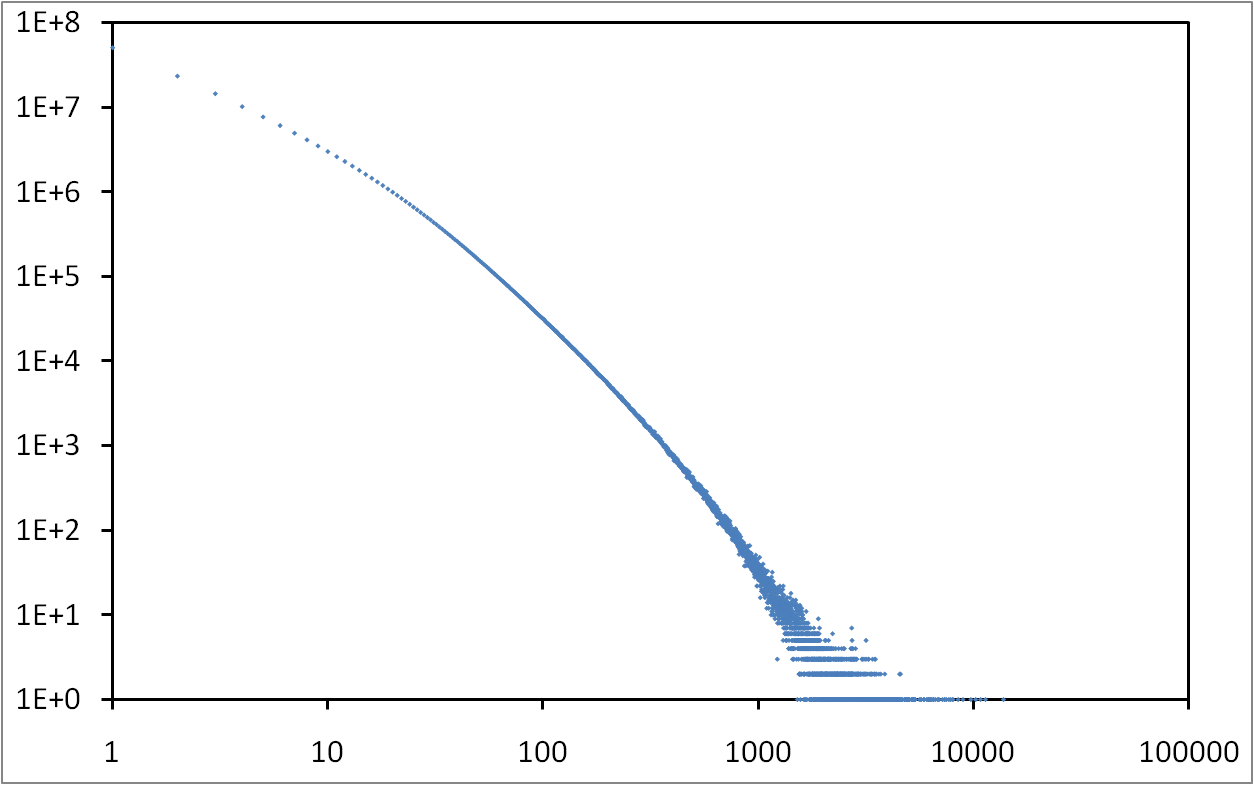
This paper presents a capture of the queries managed by an eDonkey server during almost 10 weeks, leading to the observation of almost 9 billion messages involving almost 90 million users and more than 275 million distinct files. Acquisition and management of such data raises several challenges, which we discuss as well as the solutions we developed. We obtain a very rich dataset, orders of magnitude larger than previously avalaible ones, which we provide for public use. We finally present basic analysis of the obtained data, which already gives evidence of non-trivial features.